
Decarbonization is not its design
On the rationality of resistance to the (now-beleaguered) Appalachian Regional Clean Hydrogen Hub project

Broadly, there have been two positions on carbon capture and storage (CCS) among liberals and leftists. First, there is its, to varying extents, qualified advocacy as something that must be appropriated if we seek to meaningfully draw down atmospheric carbon stock and/or ongoing carbon emissions at a pace the climate crisis demands, as argued in different ways by Christian Parenti, Holly Buck, and Andreas Malm. Typically, special emphasis is placed on direct air capture (DAC), as the signature “negative emissions” carbon capture technology. For those unfamiliar, most DAC projects, such as Occidental Petroleum’s STRATOS facility in South Texas, use big fans to suck up ambient air and scrub it of trace concentrations of carbon dioxide. Other DAC methods have also been proposed, such as olivine weathering, biorefinement of algae, and electrochemical DAC, but only traditional methods (liquid-based solvents, like STRATOS, or solid-based like the Climeworks project in Iceland) present anything close to what could be called industrial-scale feasibility.
That said, point-source capture sequesters far, far more carbon than DAC globally: 63 Mt CO2/year vs. 0.01 Mt CO2/year. Moreover, the majority of the carbon captured is reutilized in ‘enhanced oil recovery’, where it is reinjected underground to allow for the extraction of even more oil—notably EOR is where the technique first originated. For boosters, however, this does not present insurmountable drawback but merely proves that, while there are certainly political-economic constraints to its upscaling, CCS is scientifically rational, regardless of how it is currently used. Even as they admit that its current deployment is too closely aligned with fossil fuel interests, the point for them is that technology is at least potentially separable from its historical relations of production. Success thus depends less on the technical design of CCS than, first, the economic feasibility of upscaling and, second, whether it will be used For Good—that is, whether it will remain under the control of a capitalist class whose interest lies less in atmospheric cleanup than profit-making, or whether it can be appropriated by an ostensibly ‘democratic’ ‘state power’.
That is the first left-liberal position on CCS. On the other hand, there is a broad critique of CCS, prevalent among environmentalist groups, who for these same reasons—i.e., the existing conditions of its development and deployment—see it as a superficial “technological fix” which offers little more than justification for delaying the drawdown of the fossil fuel industry. As a recent ProPublica piece argues, to whatever extent CCS has been ‘proven’, it is only in the service of fossil fuel expansion, and at orders of magnitude smaller than the gigaton-scale storage proposed necessary to meaningfully reduce carbon emissions. The latter will create much larger CO2 plume volumes, which will be much more expensive to monitor and much more difficult to prevent migration of, potentially leading to leaks at the surface and thus undermining its purpose as a climate solution.
Further, CCS adoption itself entails exorbitant new energy expenditures. Point-source capture exacts what is known as an ‘energy penalty’, meaning CCS equipment requires additional energy, which must be drawn either from where the plant is installed (that is, if it is used to specifically capture gas- or coal-fired power generation emissions) or from a separate power source. Sorbent-based systems currently require anywhere between 2000 and 3000 kWh per CO2 captured, and total energy penalty was estimated by the IPCC to increase the fuel requirements anywhere between 13% and 44%. The question thus becomes who or what sources will supply the additional power to meet this demand, and environmentalists are correct to worry it will be the fossil fuel industry, which has already touted CCS as gifting the industry a new “social license to operate.”
Both sides have their well-earned criticisms, but I’m more interested in how they often seem to talk past one another at two different levels of analysis—what I will call the political-economic versus the technical-technocratic. On the one hand, as the boosters rightly observe, high upfront costs, low rates of profitability, and limited market for captured carbon are all serious roadblocks to CCS’s development under capitalism. This is after all one reason they suggest this technology must be subsumed by the state if it is to become an effective instrument for decarbonization. On the other hand, if, as Parenti says, the environmentalist opposition is too “stateophobic” when it comes to large-scale infrastructural projects, the converse could be readily said of the CCS instrumentalists, who are far too naively “stateophilic,” relegating the very complicated and important question of deliberation and planning at scale to an ill-defined but, we hope, well-intentioned ‘state power’.
Put simply, what “state” are we even talking about? Both the liberal-democratic state and the so-called workers’ state have not exactly proven themselves wellsprings for emancipatory, convivial life, particularly when it comes to large-scale infrastructural projects. Soviet power replaced the bourgeoisie with bureaucrats with little social let alone ecological accountability and even less transparency in environmental governance decision-making. Thus, as the latter ‘techno-pessimists’ correctly recognize, both kinds of states remain resolutely utilitarian in their approach to both technological progress and environmental stewardship. When the rubber meets the road, they characteristically steamroll local opposition in the name of a cold, depoliticizing, technocratic calculus of ‘necessary trade-offs’ in the name of ‘common interests’.
The point, to be clear, is not that ‘technological progress’ can only be pursued when there are no trade-offs. The point is rather that the argument that all we need to do is make CCS more ‘democratic’ handwaves rather than confronts the underlying conflictuality of any and every technological development.
Here, Holly Buck has been more sensitive than most on the pro-CCS side. In her book After Geoengineering, she both acknowledges the risks of top-down technocratic management as climate solution and in turn insists on the importance of something like mass political education and a popular technical culture for any meaningfully ‘public’ sanctioning of CCS. Yet even in her account, this ‘demand’ for doing CCS the right way is presumed to be the inherent interest of an ill-defined ‘we’, and to be asked of an ill-defined state. It is in other words not drawn from political-economic conditions as they are but from an idealist vision of how, in her view, they ought to be—and one that unfortunately for this reason joins the chorus of instrumentalists calling out the environmentalist critique of technology as irrationally dismissive, even ‘class-compromised’, as she has recently suggested of those opposing AI data centers.
This analytical separation of technology as neutral, qua ‘scientific’, from the political-economic is reminiscent of Amadeo Bordiga’s materialist critique of utopianism:
Although the utopian does see the effects of present-day society (in fact Marx praises respectfully some of the masters of utopian thought), his error lies in deducing the shape of future society not from a concatenation of real processes that link the course of the past to that of the future, not from natural and social reality, but from his own head, from human reason. (2020, p. 453)
What if, instead of handwaving conflictuality, we thus were to develop a perspective immanent to the ongoing conflict between the technological and the political under capitalism? What is required from this vantage point is something like what Adorno called a “rational critique of reason,” precisely to the extent to which instrumental reason has assumed the very form of modern, technological society. But, as Andrew Feenberg has added, this rational critique of reason must itself validate “the rationality of actual resistance” to its “alienated technical arrangements” (2017, p. 8). Thus aligned with what Max Ajl describes in A People’s Green New Deal, it is essential for any materialist politics to not dismiss but engage the alternative rationalities that have already emerged—neither from the idealized design of CCS, nor from the utopian position of an imagined social-democratic or socialist state power or even a popular ‘we’ that could one day swoop in, seize this idealistic technology, and use it to save us—but from the existing albeit nascent resistance to this either/or which takes as inevitable our current—and as Meszaros would remind us, ‘merely historical’—form of ‘technological progress’.
The rationality of resistance to ARCH2
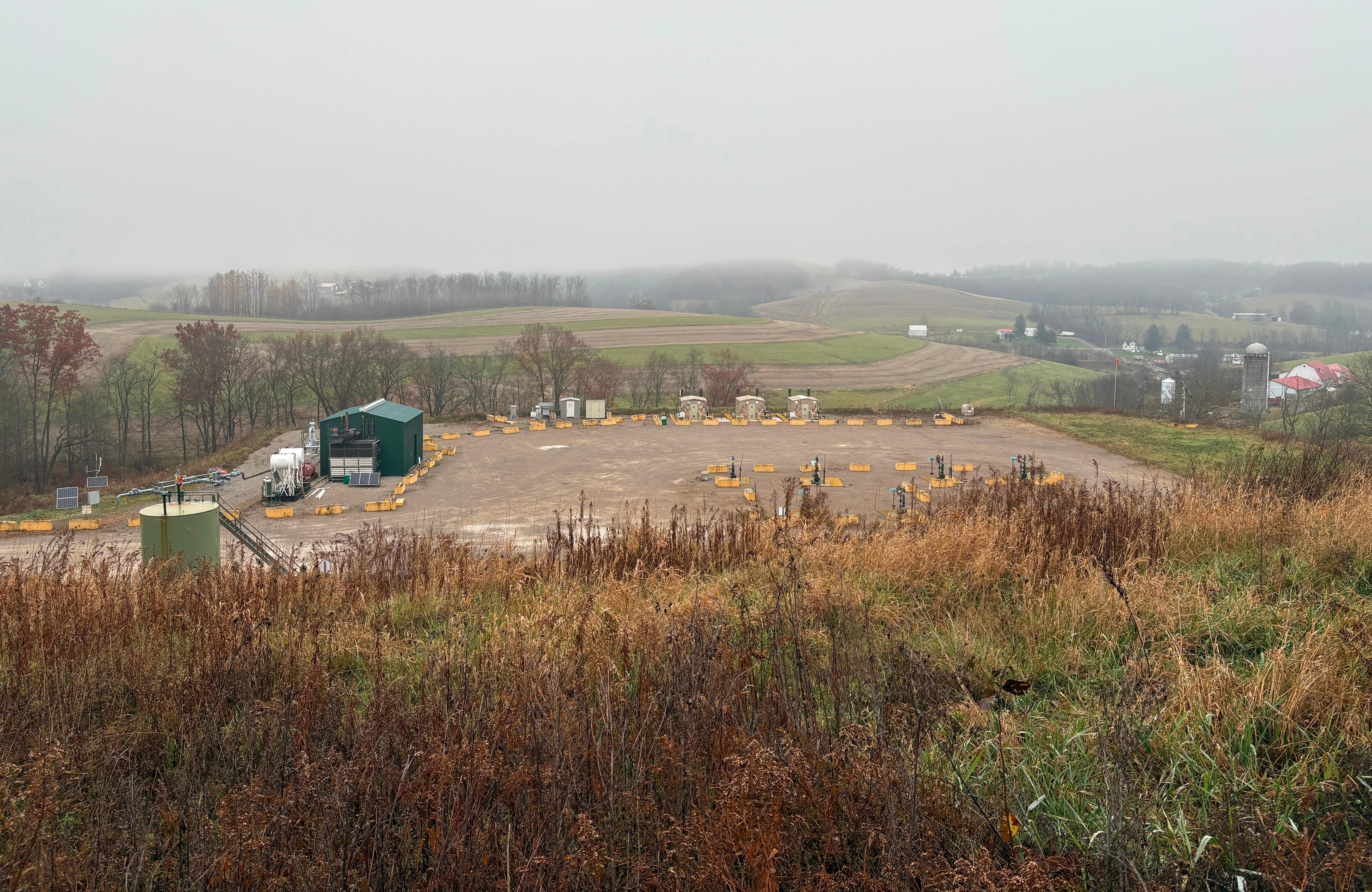
ARCH2 is one of the seven “hydrogen hubs” that had been slated for a roughly $1 billion share of the $7 billion earmarked by the 2021 Infrastructure, Investment, and Jobs Act. While the hydrogen hubs are specified by the DOE’s “Pathway for a Commercial Liftoff of Hydrogen” to be diversified in both sources of hydrogen and ultimate end uses, the Appalachian project specifically aims to leverage the region’s abundant natural gas reserves to produce “blue hydrogen”, that is, hydrogen conventionally produced through steam methane reforming, only now with the carbon dioxide emissions resulting from this process being ostensibly captured and sequestered underground. This is what makes CCS an essential technology for the hub: without it, it’s just plain old highly carbon-intensive hydrogen production.
The intended end uses of ARCH2-produced are, unsurprisingly, laughable in terms of both their economic viability and their ability to meaningful reduce carbon emissions. They include things like residential heating and blending hydrogen in natural gas streams and co-firing at existing power plants (as well as other downstream industrial appliances, e.g. stoves), in the aim of increasing the blend until at some point former natural gas plants (and other end uses) are fully powered by hydrogen. But replacing natural gas with its inherently more expensive and less efficient product makes little economic sense. It also won’t bring down carbon emissions, at least in the short term, because of the increased power required to produce hydrogen (assuming that power is drawn from a partially fossil-fueled electricity grid). For this reason, it in fact risks raising them until very high blend rates are achieved—rates that would require replacing steel gas pipelines with polymer-based materials to avoid embrittlement.
Nevertheless, ARCH2 and the other hydrogen hubs were heavily promoted by the Biden administration and its supporters, and alongside wind and solar development became electoral rally points to boast promotion of union jobs and “environmental justice.” In particular, President Biden’s late-tenure Executive Order 14008 established the Justice40 Initiative, which mandated that a number of federal climate, housing, and energy investments, including the hydrogen hubs, realize 40% of their “overall benefits” within the communities in which these projects are constructed.
At an ARCH2 Open House in January 2025, I asked both Hub representatives and individual project developers what “40% of overall benefits” meant in concrete terms for ARCH2. I did not receive a clear answer, only vague gestures toward workforce development and the fact that hydrogen consumption was an inherent environmental benefit relative to fossil fuels. This reminded me of a prior gas industry event I attended, where gas producers interpreted “environmental justice” to also include counterfactuals: why, in other words, shouldn’t a lack of leaks, spills, and accidents itself be credited as a ‘community benefit’?
The return of Trump to office has cast a great deal of uncertainty onto the future the hydrogen hub program. On Day 1 of his second term, he rescinded President Biden’s Executive Order 14008 and hence removed the federal compliance mechanism backing Justice40. By the fall of 2025, the DOE rescinded funding for the two West Coast hubs. In its 2027 Budget Request, released in early April 2026, the administration asked Congress to “permanently cancel” $3.25 billion of the hub program’s funding and also repurpose $3.5 billion to support “baseload power.” A few weeks after this budget request was released, however, ARCH2 received word from DOE that the hub would stay within the program.
But even before this electoral turnover, ARCH2 was already facing opposition concerning its “Community Partnership” mandate detailed in the DOE’s Funding Opportunity Announcement. Notable local environmentalist groups like the Center for Coalfield Justice, West Virginia Rivers Coalition, the Buckeye Environmental Network (BEN), and the Ohio River Valley Institute voiced opposition to the project, citing public health and environmental justice concerns, suspicion around blue hydrogen’s claim to actually lower lifecycle greenhouse gas emission, and a growing recognition that “partnership” did not in fact concern participation in design or development but only a predetermined pathway to advertise community consent within the fixed hierarchical structure of the project.
In May 2024, this led 54 Appalachian organizations to sign a letter to the Office of Clean Energy Demonstrations rebuking its orientation as “solely to the advancement of the Appalachian hydrogen hub—community concerns, pollution burdens, and environmental injustice notwithstanding.” Between then and Trump’s return, little was done by the Biden administration to address these concerns. In November 2024, for instance, Veronica Coptis of the Center for Coalfield Justice had observed in November 2024 an ongoing lack of transparency around project implementation, with initial applications from project developers remaining inaccessible to the public: “It’s not possible for communities to give meaningful input on projects when we literally don’t know anything about them.” But what perhaps sewed the most distrust in the ARCH2 project was its inclusion of several notorious gas industry companies, including EQT, who was tapped to organize the hub’s “community advisory committee.” The nation’s second-largest natural gas producer is better known among Appalachian residents for its numerous environmental permitting violations committed since the start of the fracking boom. As Matt Mehalik of the Breathe Project commented to EHN: “Choosing EQT to run this part of the project shows the lack of real community engagement, the lack of community trust, the lack of community transparency that surrounds the [ARCH2] community benefits process.”
In 2025, the BEN further implored Ohio legislators to reconsider ARCH2 due to the specific technical risks associated with CCS transport and storage: pipeline ruptures resulting from the high pressurization of CO2 necessary to transport it efficiently as a supercritical fluid, the existing poor track record in Ohio for managing wastewater injection wells from fracking the Utica and Marcellus shales, and the risk of subsurface CO2 flume migration amplified by the over 300,000 previously drilled oil and gas wells already drilled across Appalachia.
But as local environmentalist organizations recognize, this is not simply a disagreement about technical risks but an asymmetry concerning who is recognized as capable of evaluating them. Community groups are not treated by the state as legitimate epistemic authorities. Their role is simply and strictly to give blessing to a project whose technical design is effectively settled. In an email response to reporters at EHN, the DOE stated this outright: “communities will not have a direct right of refusal. This is not a requirement of the H2Hubs program.” Rendered unquestionable are thus the techniques of ‘transition’. Environmental politics institutionalized through policy is reduced to a strategy of securing public acceptance, not deliberating over alternative technical pathways or rationalities.
Recalling what was said above, here is where I see the opportunity for what Feenberg calls a “design critique,” namely, on the basis of what those resisting CCS development in Appalachia are saying. This design critique challenges the presumption that deleterious consequences will result solely from the misuse of otherwise rational technology, and instead makes possible an investigation of the appearance of neutrality of the technology in question. As Feenberg argues, highlighting this “formal bias” means expanding the context “within which claims to rationality are evaluated” (2017, p. 9). While this is meant in Feenberg’s account in terms of how the implementation of universal technical standards nevertheless lead to differentiated outcomes, I think we can also understand this enlarged context as taking into consideration the challenge against the claims of CCS boosters to carbon reduction.
This would include not only BEN’s technical concerns but also, for instance, a full evaluation of all associated lifecycle carbon emissions, as ORVI has called for. Such an assessment would thus account for how CCS substantially increases a power facility’s electricity demand and therefore makes electricity generation less, rather than more, efficient. It would also account for the irrationality latent in the opportunity costs of prolonging the operation of fossil fuel infrastructure that might have otherwise been retired. In this way, a design critique invites a broader challenge to the rationality of current CCS strategy on technological, political-economic, and environmental grounds simultaneously.
None of this necessitates ‘localism’—the common gripe of ‘big state’ eco-modernists supportive of CCS. On the contrary, evaluating CCS ‘on the ground’ requires a system-wide perspective capable of tracking its extensive industrial interdependencies. The point is that local opposition has already articulated such a critique, connecting technical performance, entrenched political power, and regional political economy in ways ignored by the Biden administration. One may retort that these conditions are not what leftwing CCS boosters would have preferred, but the point is these are the circumstances in which we find ourselves and under which the ‘energy transition’ is actually unfolding. Future society will be shaped not by idealized models of democratic planning but by the contradictory institutional arrangements inherited from capitalist development. A materialist politics of energy transition must work from within these contradictions rather than abstracting away from them.
To that end, it is important to stress that the Biden administration’s approach was, by far, the most human-faced state-led industrial policy in this country in recent memory—out of admittedly a rather grim selection of technocratic and/or outright reactionary presidential administrations. The fact its large-scale industrial projects reproduced the same techno-managerial forms of governance characterized by ‘New Deal’ project it modeled itself after warrants asking whether the state is itself an adequate institutional form for deliberation and planning at scale. At the very least, it is difficult to describe such planning as ‘democratic’ in the absence of economically powerful and institutionalized leftwing organizations and, moreover, a broadly politicized technical culture capable of meaningfully participating in technological development rather than simply offered the pseudo-opportunity to consent to it.
you should check out Nic's book and some of his current writing on the tech resistance Q e.g. https://nicholasbeuret.substack.com/p/are-wind-farm-protesters-really-anti