
Historical Transformations in the Oil Price Regime
The Breakup of Standard Oil and the Rise of Prorationing (1911-1939)

Continuation of a previous post…
Standard Oil’s destruction of the petroleum exchanges and subsequent unilateral institution of its posted price regime had a significant damping effect on what had been an extremely volatile commodity market (Brown and Partridge, 1998). Average oil price fluctuation fell from 53% per year, prior to the mid-1880s, to an average of 24% per year during the company’s reign (McNally, 2017, p. 32). Yet, the posted price regime was ultimately short-lived. After a slew of state-level legal battles, the U.S. Supreme Court ruled in 1911 that the Standard Oil Trust was in violation of the 1889 Sherman Antitrust Act, ordering its dissolution into thirty-four independent companies. While many large refineries still continued to use something like posted prices for long-term contracts, a growing mass of marginal barrels became subject, once again, to major price swings.
Perhaps ironically, immediately following the collapse of Standard’s monopsony power over the upstream sector independent producers began advocating for the centralized, rational management and conservation of oil. A string of major oil discoveries in Oklahoma had led to the formation of the Independent Producers League by 1914, which lobbied the Oklahoma Corporation Commission (OCC) to set controls on the production of the state’s oilfields. In response, Oklahoma instituted the first prorationing mechanisms in the country, prohibiting pipelines from purchasing oil from the Cushing and Healdton fields for less than a new price floor set by the OCC.
In 1915, the state legislature granted the OCC further discretion. It allowed for the Commission to throttle production whenever it found evidence of either physical or economic waste. That is to say, the OCC could now regulate production not only if oil was wasted through dumping, leakage, evaporation, etc. but also if supply exceeded available demand. This is particularly notable, as the Texan counterpart to the OCC, the Texas Railroad Commission (TRC), was granted powers only to regulate physical waste, while being explicitly excluded in state statute from regulating economic waste.
Through the 1920s, however, these production controls remained “toothless and weakly enforced” (McNally, 2017, p. 47), and oil producers of the largest producing states were mostly left to regulate themselves. As geographer Matthew Huber (2011) has noted, it was only when the whole oil market risked total collapse that the state would finally step in and meaningfully mediate oil prices. This occurred, famously, after the discovery of the massive East Texas Oil Field by Columbus “Dad” Joiner in 1930. In its wake, we see the start of the gradual consolidation of what would become a new and very effective mid-20th century price regime: prorationing.
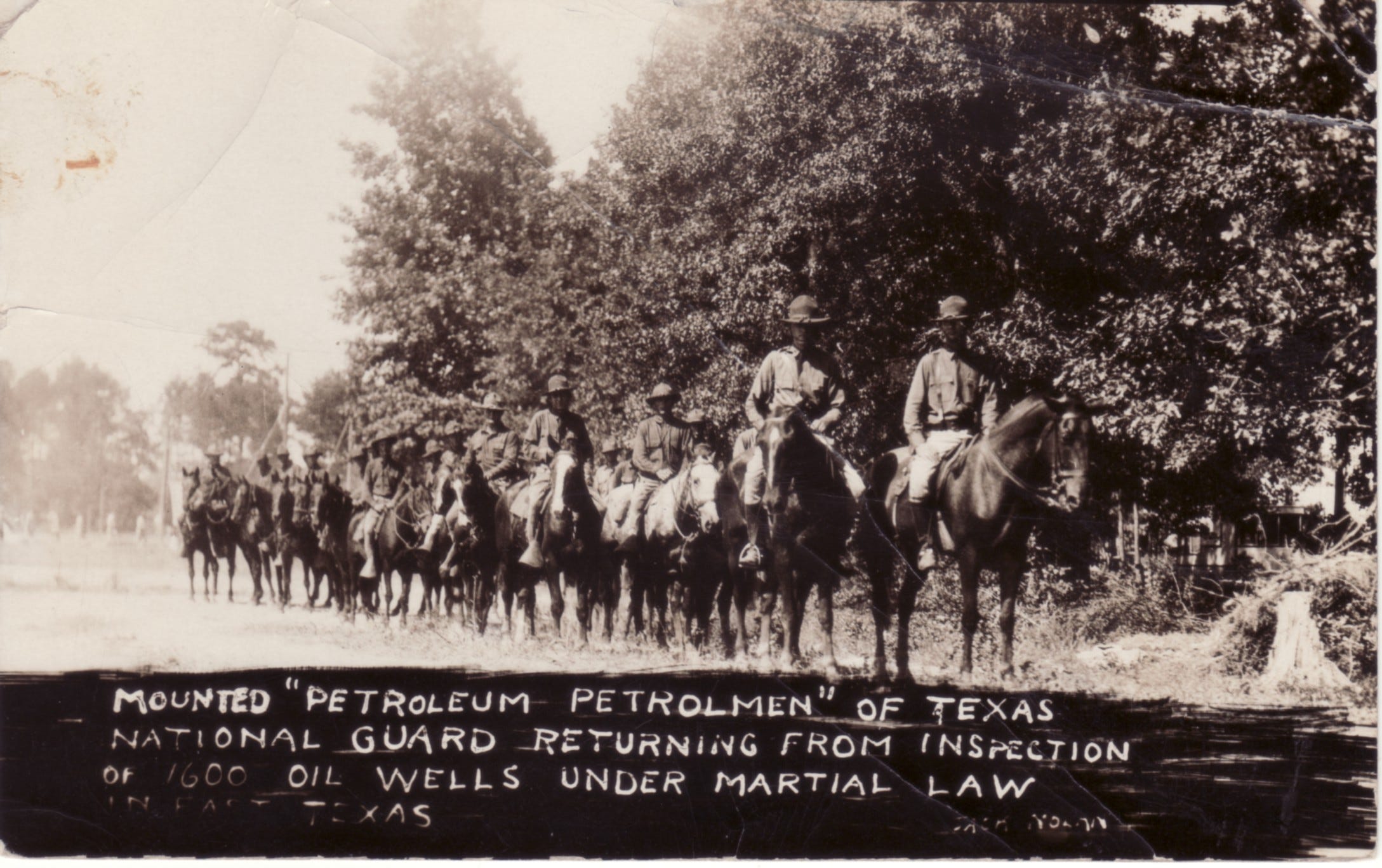
News of the “Black Giant” spread quickly across the country, spurring “thousands of land deals in a matter of weeks” (McNally, 2017, p. 72). Soon enough, 350,000 barrels of East Texas oil were flooding into the US market everyday—15% of total domestic consumption. Oil prices crashed from $1.15 in 1930 down to $0.15/bbl in 1931 (Huber, 2011, p. 820). To make matters worse, in July 1931 a federal district court ruled against state-led efforts to throttle supply from the East Texas field, affirming that the TRC only had authority to regulate physical, not economic, waste. After this ruling, rumors begun to circulate across the oil patch that a “coalition of landowners and 1,500 oil producers” were plotting to sabotage oil infrastructure in the attempt to restore prices to more profitable levels (ibid., p. 821).
Fearing a “state of insurrection,” Texas Governor Ross Sterling declared martial law, dispensing soldiers to enforce mandatory prorationing of wells across the state. Meanwhile, on August 3rd, 1931 a federal court ruled that the OCC quota system in Oklahoma, i.e. the economic regulation of production, was illegal—just as regional oil markets risked the folding of thousands of high-cost independent producers. The following day, Oklahoma Governor William “Alfalfa Bill” Murray followed Sterling’s lead an ordered troops to shut down 3,106 active wells in the state: “The state’s natural resources must be preserved,” ‘Alfalfa’ Bill declared, “and the price of oil must go to $1 barrel; now don’t ask me any more damned questions” (qtd. in McNally, 2017, p. 69).
In September 1933, the Roosevelt administration incorporated the National Industry Recovery Administration (NIRA) (see Murphy, 1949). The Code contained numerous formal measures to bolster the prorationing price regime first catalyzed by the East Texas crisis. In particular, the Code invoked federal powers over interstate commerce regulation in Section 9(c), which “declared illegal any interstate shipment of hot oil,” that is, oil “produced in excess of state authorizations” (Libecap, 1989, p. 838).
Illegal purchases and sales persisted, however, through nighttime production, hidden pipelines, and at least one case of covert storage dispensed through bathroom faucets (McNally, 2017, pp. 77-78). Significantly, these schemes were often concocted not simply in the name of political defiance, i.e. against ‘big government’, but because drillers were in desperate need to pay back short-term loans:
A large part of the original investment of the independent operator is usually borrowed—probably at a premium because of the speculative nature of the enterprise. Assuming that the principal sum draws interest of at least 6% and must be amortized in the first three or four years of operation and that 1/8 of the gross income is paid out as royalty, and that a further outlay for production taxes, gathering, transportation and operating expenses is necessary before an operator can realize any income from his well, it is obvious that an insufficient volume of production, even at a “fair” price, tempts an operator, burdened with such unavoidable “costs,” to increase his volume by illicit production. (Marshall and Meyers, 1933, p. 704, note 8)
While the Supreme Court ruling of Panama Refining v. Ryan (293 U.S. 388, 1935) had declared Section 9(c) of the Code unconstitutional in January 1935, it was reinstated a month after by the “Hot Oil Act,” sponsored by Texas Senator Thomas Connally. Later that same year, US Congress went further in support of interstate regulation of the oil trade through the ratification of the Interstate Oil Compact Commission (IOCC), which granted agencies in Kansas, Louisiana, Oklahoma, and Texas the formal authority to proration their respective state’s oil output. Thus, by 1935, the combination of new congressional measures in place to restrict the sale of hot oil, and the additional regulatory power vested in the Interstate Oil Compact to control output, meant domestic oil markets once again saw price stability not seen since the days of Standard Oil.
Once formalized, this new price regime contained three major mechanisms to control oil production. The first was the legal authority to shutdown oilfields through police force, as witnessed in 1931 in Texas and Oklahoma. The second was the ability to impose an upper limit to a given field’s “maximum efficient rate” (McNally, 2017, p. 80). This allowed for the stabilization of reservoir pressure and hence the conservation of oil through the optimization of production yields. The third and most complex (and contentious) was “market-demand proration,” through which supply was actively regulated to match anticipated demand (Libecap, 1989, p. 850). Market-demand proration was assessed through monthly or bimonthly meetings between regulators and major buyers of crude oil, with the latter submitting “nominations” of quantities of oil they intended to purchase over the next business cycle. Then, public officials from each state estimated available supply over this period and subtracted from that number exempted wells (returned to in the next paragraph), imports, and supply from other states. The resulting total was known as the state’s “call” for crude oil, which was used to determine the prorated quota for each wellhead in the state.
Despite its contentions, this new price regime proved quite effective. Production outputs closely tracked demand and prices remained relatively stable throughout the period of its institution. This is despite the discovery of a number of new oilfields across the United States, which would go on to raise the estimation of total U.S. reserves from 908 million barrels in 1934 to 3.3 billion in 1970.
Crucially, some of the biggest supporters of prorationing—or what was, in effect, the US government-sponsored cartelization of domestic oil production—were independent producers, many of whom operated high-cost “stripper wells,” defined as those producing less than ten barrels of oil per day. Given the new presence of cheap oil flowing into domestic markets from the East Texas Oil Field, state regulators worried that high-cost producers would be forced out of business with a sustained decline in oil prices. This, in turn, would devastate “local economies and the careers of politicians if thousands of small, high-cost oil firms, refineries, and well service and supply companies were to fail” (ibid., p. 837). As Huber observes, the price regime’s assessment of “reasonable demand” was thus a product “not of market equilibrium but of a concerted effort to protect high-cost, often independent, oil producers from the ruinous effects of market competition” (2013, p. 184).
This is only half the story, however, as many independents were themselves also involved in low-cost plays—for instance, the 1,000 or so small independents operating in the East Texas field by 1935 (Prindle, 1981). Thus, while the Interstate Oil Compact did render exempt operators of high-cost “stripper wells” from the quota system, it also protected small low-cost independents through preferential production allocations. Until 1964, for instance, the IOCC deliberately biased the distribution of monthly quotas toward depth over acreage (the latter requiring larger capital allocations, i.e. for lease purchases). While a well drilled 1,000 feet servicing 10 acres was allowed to produce 18 barrels a day, every additional acre was granted one additional barrel of allowable production. In contrast, for every 500 feet of increased depth of the well, 9 more barrels were allowed, up to 7,000 feet. Beyond 7,000 feet, allowables increased to 38 barrels per 500 feet, up to 10,000 feet deep. Thus, oil producers holding smaller acreage benefited more greatly from quotas by digging deeper rather than wider. The upward rise of production cost witnessed through the midcentury thus resulted from the combination of two political-economic dynamics: the prorationing price regime helping keep high-cost producers viable while also accommodating less efficient methods in low-cost, smaller producers, such as excessively or inefficiently deep wells (Libecap, 1989, p. 855).
Drawing on my previous posts, we can thus say that the interstate regulation of the domestic oil trade helped simultaneously facilitate an increase in the organic compositions of capital across both high- and low-cost independent producers, subsequently discouraging them from investing in virgin fields. As a result, oil producers with relatively lower organic compositions of capital were able to capture very large differential rents. To point back to Marx’s analysis of Differential Rents I and II, both forms of rents are simultaneously determined by the contradiction between landed capital and productive capital, which in the case of oil was increasingly mediated through the mid-20th century by this burgeoning prorationing price regime.
Put differently, it was clearly not the case that there was some inevitable shift of oil production from more to less ‘naturally’ productive oilfields. Through the early 20t century, low-cost fields were continuously being discovered in the United States, but any rise in the organic composition of capital was checked ultimately not by market conditions but by the prorationing price regime. Indeed, in addition to well-deepening, mandatory quotas also created the incentive to increase the capital intensity of oilfields via well densification, given that quotas were imposed not on field production but on individual wellheads. Thus, while “spare capacity” swelled as more wells were produced at lower quotas per well, the increase in capital outlays made it that much more difficult to realize a return on investment (McNally, 2017, p. 83).
Although McNally heralds well densification as the means by which the prorationing price regime loosened the stickiness of oil supply by expanding productive capacity—and, in turn, helping further stabilize oil prices—keeping the country’s maturing fields online meant oil prices could continue to be determined by higher-cost producers than would otherwise be economically feasible. This situation would prime the onshore industry for a rude awakening in the 1970s, as the production prices of oil saw a dramatic readjustment with: the de-insulation of the US domestic oil market, the breakdown of the “International Petroleum Cartel” (i.e., the Seven Sisters’ cartelization of European markets), and, with the rise of OPEC, ironically the first genuine internationalization of oil markets in history (see Bina, 1985).
By way of conclusion, it’s important to remark on how oilfield development was financed during this time period. Through the early 20th century, access to finance capital among independent producers was very limited. As Bernard Clark reports (2016, p. 43), small producers had little contact with bankers, lawyers, or accountants. When producers did take loans, it was typically short-term and only against their tangible capital assets, i.e. either produced oil or oilfield equipment (ibid., pp. 99-100). This, in addition to the absence of petroleum exchanges, meant there was little means for producers to securitize revenue against future price risk.
While prorationing “made quick profits in the oil industry more difficult than ever,” it also signaled a new alignment of time horizons of investment between industrial and financial capitals (Mount, 2008, p. 226). Bankers began to lend with more confidence precisely because cash flows became more predictable with slowed and rationalized production as, simultaneously, this institutionally-mandated slowdown of the rate of turnover of capital spurred the need for long-term lines of credit (Clark, 2016, p. 96). Perhaps the most significant outcome of this temporal alignment was the innovation of “reserve-based loans”, where regional energy banks allow oil producers to collateralize oil still in the ground to finance ongoing oilfield development.
The possibility of reserve-based loans was contingent upon not only the new prorationing price regime but also the production of new statistical information about the oilfield (Tinkle, 1970, p. 227). In part, oilfield production accounting was facilitated by the aforementioned state and federal bureaus, who were now charged with regulating the onshore oil business. Indeed, the breakdown of oil markets during the early 1930s inspired new efforts to amass and centralize information about the oil industry. To be sure, the US Bureau of Mines had already been providing estimates of oil demand for the Federal Oil Conservation Board by 1929, but the discovery of the great East Texas field granted new legal weight and economic significance to these assessments.
But again, producing trustworthy information about the oil industry became essential not only for regulatory agencies but also for increasing the lender’s confidence that the borrower-producer would be able to service his or her debt. While other primary industries certainly had their own investment risks in productive investment (e.g. crop failures, input bottlenecks, etc.), these paled in comparison to the challenge of evaluating oil prospects. Particularly under the new restrictions on output, loans for ‘oil in the ground’ would only be worthwhile—from the perspective of a potential financier who typically knew little about the ins and outs of the oil industry—if a reasonable, objective assessment of the value of the oilfield could be procured.
For this reason, the proration price regime became “the catalyst that brought about studies leading to the adoption of sound engineering practice in petroleum production” (Murrell, 1964, p. 12). Seeking to mediate this gap between financiers, regulators, and oil producers, the oil famous prospector Everette Lee DeGolyer had founded a consulting firm in 1939 with one of his colleague’s, Lewis MacNaughton, to develop a “consistent and accurate system of valuation for oil properties” (Mount, 2008, p. 229). Speaking as the chairman of their consulting firm, John Murrell had remarked:
[DeGolyer and MacNaughton] believed that proration, now a fact, would bring about stability of production and temper, if not eliminate, the wide swing in prices that plagued the industry. They foresaw that curbing production would drastically reduce the sudden large income that had hitherto rewarded one who made a discovery. Such reductions, they surmised, would bring about a need for long-term financing for many entities in the industry. (1964, p. 15)
DeGolyer and MacNaughton took consulting jobs worldwide, traveling by “jeep, junk, and jackass to carry out assignments. They have trudged across the tundra and slogged through swamps. They have sweltered in Saudi Arabia and shivered in Saskatchewan” (ibid., p. 23). To aid in the dissemination of oilfield information, DeGolyer and MacNaughton organized “schools” for financiers and insurance officers on all aspects of the inner workings of the upstream oil industry (ibid., p. 17).
Perhaps their biggest contribution was the collection and classification of massive amounts of oilfield data, which had previously been siloed across thousands of independent producers. This catalog of data about “production memoranda, well completion, and scout reports” would eventually amalgamate in millions of note cards housed in the firm’s Dallas office and used to assess the valuation of thousands of prospects (Mount, 2008, p. 231). This assessment could then be used by a bank to assess the prospect as against the dollar amount of a loan. Later, this catalog was also used to assess supply and demand, state-by-state productive capacities, or “trends in the market value of properties and analyses of the financial position of a large number of companies” (Murrell, 1964, p. 24).
The business of economically evaluating an oil reserve, however, remained deeply fraught. Despite all of the information collected by firms like DeGolyer and MacNaughton, there was in the end very little certainty about how much oil could actually be produced from any given field until after it was actually produced. All oilfields are unique in their geological makeup, and there was in truth no ready-made, universal pricing model for economic oilfield assessments. All that one could do was infer value through comparison to roughly analogous producers tapping into roughly analogous fields at various stages of maturity.
DeGolyer knew all of this intimately: while at Mexican Eagle as a young geologist, he was asked by the US federal government to find a method of computing depletion allowances for the purpose of tax allocations within the oil industry. Quickly, DeGolyer had grown frustrated with this task, as the necessary information to assess depletion was unavailable; thus a “single curve” which could “fit more than one oilfield was unrealistic” (Mount, 2008, p. 229). In February 1919, he was forced to conclude that a “formula for depreciation is not possible.” Despite these early frustrations, the appearance of the reliability of technical assessments would nevertheless become essential means for small producers to gain access to finance capital from the 1930s onwards. On their basis, energy lending from regional energy banks grew to become a massive source of credit for oilfield development by World War II. This would change during the postwar period, however, as the internationalization of the oil trade meant reliance on state proration became a less meaningful securitization against price risk, particularly as imports began to overtake domestic production (Clark, 2016, p. 105).
References
Bina, Cyrus. 1985. The Economics of the Oil Crisis: Theories of Oil Crisis, Oil Rent, and Internationalization of Capital in the Oil Industry. London, Merlin Press.
Brown, John Howard, and Mark Partridge. 1998. “The death of a market: Standard Oil and the demise of 19th century crude oil exchanges.” Review of Industrial Organization 13, pp. 569-587. https://doi.org/10.1023/A:1007795128137
Clark, Bernard. 2016. Oil Capital: The History of American Oil, Wildcatters, Independents and Their Bankers. Self-published.
Huber, Matthew T. 2011. “Enforcing scarcity: Oil, violence, and the making of the market.” Annals of the Association of American Geographers 101(4), pp. 816-826.
Huber, Matt. 2013. “Fueling capitalism: Oil, the regulation approach, and the ecology of capital.” Economic Geography 89(2), pp. 171-194. https://doi.org/10.1111/ecge.12006
Libecap, Gary D. 1989. “The political economy of crude oil cartelization in the United States, 1933-1972.” The Journal of Economic History 49 (4), pp. 833-855. https://doi.org/10.1017/S0022050700009463
Marshall, J. Howard, and Normal L. Meyers. 1933. “Legal planning of petroleum production: Two years of proration.” Yale Law Journal 42, pp. 702-745. http://hdl.handle.net/20.500.13051/3937
McNally, Robert. 2017. Crude Volatility: The History and the Future of Boom-Bust Oil Prices. New York, Columbia University Press.
Mount, Houston Faust II. 2008. Oilfield Revolutionary: The Career of Everette Lee DeGolyer. PhD dissertation, Southern Methodist University.
Murphy, Blakely M. 1949. Conservation of Oil & Gas: A Legal History. American Bar Association.
Murrell, John H. 1964. “Science—skill—service: The story of DeGolyer and MacNaughton.” Adress at a National Newcomen Dinner of the Newcomen Society in North America, 19 March 1964, New York.
Prindle, David F. 1981. Petroleum Politics and the Texas Railroad Commission. University of Texas Press, Austin.
Tinkle, Lon. 1970. Mr. De: A Biography of Everette Lee DeGolyer. Little, Brown and Company, Boston and Toronto.
I would kill for a curriculum on oil